


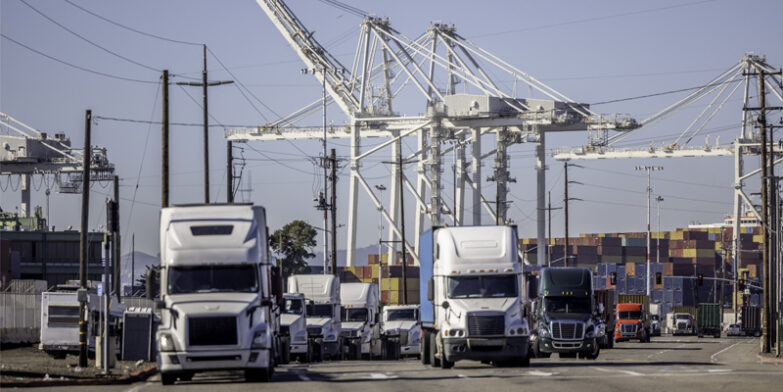
Ocean, air and trucking markets are being reshaped by tariff pauses, changing eCommerce patterns, capacity withdrawals and a gradual tightening in trucking supply.
U.S. growth is projected to ease to around 2% in 2025 as labour markets cool, trade frictions persist and tighter financial conditions weigh on investment, even though the domestic economy remains comparatively resilient versus other advanced markets.
Ocean
U.S. imports softened again in October, with forecasts pointing to monthly volume declines of around 20% compared with 2024.
Carriers have intensified blank sailings to balance utilisation, removing up to 46% of West Coast and 41% of East Coast transpacific capacity.
Markets remain oversupplied despite heavy blank sailings. Imports fell by double digits year on year through autumn, leaving many carriers reliant on rate-restoration surcharges to protect margins.
The U.S. “special port fee” on Chinese-built vessels and China’s reciprocal measures have been suspended for 12 months, after the countries leaders met in October.
Global schedule reliability held between 65% and 68% through Q3 and October, the strongest and most consistent performance since before the pandemic.
The Drewry World Container Index increased 4% at the start of November, marking a third consecutive rise after 17 weeks of decline. Route rates strengthened from Shanghai to Los Angeles (+6%) and New York (+4%). However, despite these gains, composite levels remain 43% lower year on year.
Carriers are expected to maintain blank sailings to defend rates. The tariff pause may lift confidence, but demand recovery hinges on U.S. retail restocking and improved manufacturing sentiment.
Air
Global air cargo markets exited Q3 2025 with solid but decelerating momentum, as September volumes grew 2.9% year on year, extending a seven‑month expansion even while manufacturing and export order growth cooled.
Asia–Europe and intra‑Asia trade lanes remained the primary growth engines, whereas Asia–North America traffic softened amid tariff uncertainty ahead of the recent U.S.–China pause.
U.S.-linked air cargo flows were particularly weak on transpacific routes, with volumes from China and Hong Kong under pressure following the end of the de minimis exemption, which triggered a sharp pullback in small‑parcel e‑commerce traffic and a significant reduction in dedicated freighter capacity. This has left overall U.S. airfreight growth flat to negative on key Asia-origin lanes.
Freighter utilisation has fallen and yields remain constrained by expanding passenger belly capacity, increasing competition for general cargo. The agreed 12‑month tariff pause between the U.S. and China is expected to stabilise transpacific flows into 2026, but a sustained rebound will depend on consumer demand and retailer inventory strategies.
Into peak season, late‑October data show global spot rates rising around 4% week on week, led by Asia‑Pacific origins as demand builds for Thanksgiving, Black Friday and Christmas. WorldACD reports particularly strong rate gains from Vietnam, Thailand, China and South Korea to the U.S.
Current market conditions broadly align with the usual run-up to Black Friday, but this year the surge has begun earlier and is holding at elevated levels for longer than normal. It is not yet clear how much of the latest uplift reflects early Christmas stock replenishment, although seasonal retail and eCommerce demand are clearly in play.
Market indicators suggest that booking patterns immediately after Black Friday will be critical in determining whether 2025 develops into an extended peak, or settles back into more typical year-end volumes.
Trucking
The market is in a fragile early‑upturn phase: demand is still muted, but capacity is tightening and spot rates are grinding higher into peak season.
Freight volumes remain soft versus prior years, reflecting weaker goods demand and pressure on freight‑relevant manufacturing, so the overall Q4 demand profile is described as “muted” rather than booming. However, holiday retail flows, e‑commerce and inventory repositioning are providing a seasonal lift, particularly on port‑driven and consumer corridors.
On the supply side, the market is seeing accelerated carrier attrition, especially among small fleets, due to higher costs, immigration and CDL rule changes, and tighter insurance and compliance requirements. This structural thinning of capacity is gradually shifting pricing power back toward carriers, even though demand is not yet strong.
Spot truckload rates are rising year‑over‑year in Q4, led by dry van and refrigerated freight, while contract rates remain comparatively soft, giving shippers leverage on longer‑term bids but less flexibility on short‑notice moves.
Most forecasters expect a slow, uneven recovery, with modest rate inflation into 2026 as capacity continues to exit and any demand improvement feeds quickly into tighter conditions.
Keep your supply chain moving with confidence.
Our strong carrier relationships and global purchasing power keep costs competitive, even in shifting markets. Paired with real-time, data-verified tracking and proactive purchase order management, we deliver the visibility and control you need to plan ahead and adapt fast.
See how Global Forwarding can help you optimise performance and reduce risk across your air and ocean freight network.
Email Adam Davies, Vice President, Global Forwarding Ltd.