


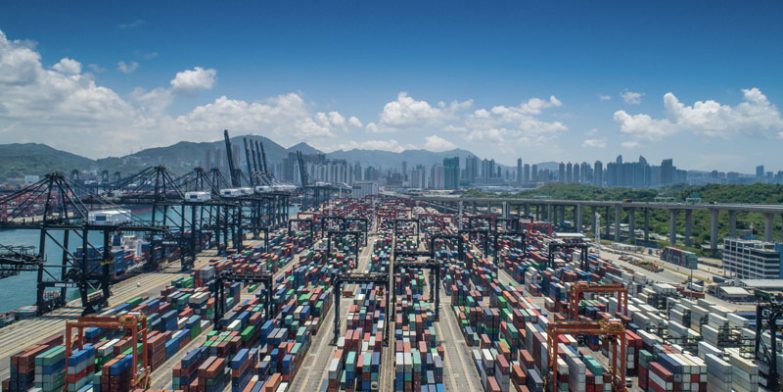
Ocean freight is in a phase where network structure and external factors, rather than simple supply-demand balance, is shaping outcomes.
Alliances are consolidating, regional services are expanding and carriers are actively redesigning their coverage, including around Ireland and Northern Europe, even as operational reliability remains uneven.
At the same time, seasonal disruption and weather-related operational challenges continue to distort available capacity. The result is a market where space may exist on paper, but predictability depends on routing strategy, carrier choice and forward planning rather than headline rate direction.
Lunar New Year Seasonal Capacity Adjustments
Chinese New Year, which began on 17 February, is the primary cause of widespread blanked sailings across east–west trades. The holiday halts manufacturing output for several weeks, prompting carriers to withdraw capacity in anticipation of lower volumes.
Across the transpacific, Asia–Europe and transatlantic trades, 136 sailings were cancelled in February, a 122% increase compared with January. Around 63% of cancellations affected the transpacific eastbound, 27% Asia–Europe/Mediterranean services and 11% the transatlantic westbound.
In total, roughly 16% of scheduled departures were removed during the mid-February to late-March period. March currently shows fewer blank sailings, suggesting a month-on-month capacity rebound of approximately 20%. However, softer utilisation, already below 85% on some transpacific services, indicates any rate recovery may remain fragile.
Weather Disruption Adds Cost Pressure
Though improving, winter conditions across Europe have continued to affect port productivity and vessel rotations.
CMA CGM introduced a $100 per container operational recovery surcharge on North Europe–India cargo from 23 February. Maersk issued advisories covering Algeciras and Tangier, while Hapag-Lloyd warned of cost pass-through risks linked to severe Bay of Biscay conditions.
These developments highlight a growing disconnect between soft spot rates and rising operational costs, with disruption expenses increasingly passed downstream to shippers.
Reliability Still Separates Carriers
Schedule performance remains inconsistent. Global reliability slipped to around 63%, with average delays exceeding five days.
Individual carrier performance varied significantly, with Maersk and Hapag-Lloyd maintaining reliability in the mid-70% range, while several carriers remained below 60%.
The gap reinforces that routing strategy and carrier selection now matter more than simply choosing a trade lane.
European Networks Are Expanding
While reliability challenges persist, carriers are simultaneously strengthening regional coverage around Ireland and Northern Europe.
CMA CGM operates direct feeder connections into Dublin, Cork and Belfast from major European hubs including Rotterdam, Antwerp, Le Havre and Southampton. The carrier also operates direct links between Dublin and Belfast to and from the U.S. East Coast and has announced a new direct call at Ringaskiddy in Cork.
Short-sea capacity is also increasing. CLdN has agreed to acquire Samskip’s container shipping and door-to-door operations between mainland Europe, the UK and Ireland. The deal includes Rotterdam connections into Belfast, Blyth, Grangemouth, Hull and Tilbury and Irish ports including Cork, Dublin and Waterford, alongside more than 5,000 multimodal units. The move strengthens combined RoRo and LoLo options across regional supply chains.
Consolidation Reshapes Global Trades
Further structural change is emerging at global level. Hapag-Lloyd is moving towards acquiring the publicly held Israeli top 20 global carrier Zim, a transaction that would significantly reshape several major trades.
If completed, the combined fleet would control roughly 22% of the Far East–U.S. East Coast market and increase Mediterranean–North America share to around 23%. The acquisition would also incorporate Gold Star Line’s intra-Asia network, expanding coverage across India, Southeast Asia and Africa.
Such consolidation could improve network density but may also reduce independent service alternatives, making routing strategy increasingly important.
What This Means for Shippers
The current market is no longer defined purely by too much or too little capacity. Instead, outcomes depend on how effectively networks, alliances and regional services interact with disruption events.
Space availability, transit consistency and cost exposure now vary significantly between carriers and routings, even on the same trade lane.
Global Forwarding works with shippers to actively plan bookings, select carriers and design routings around real operational performance, budgets and deadlines, rather than assumptions.
To review how current ocean developments may affect your supply chain, speak with the Global Forwarding team, who can help you plan shipments with greater certainty in the months ahead.