
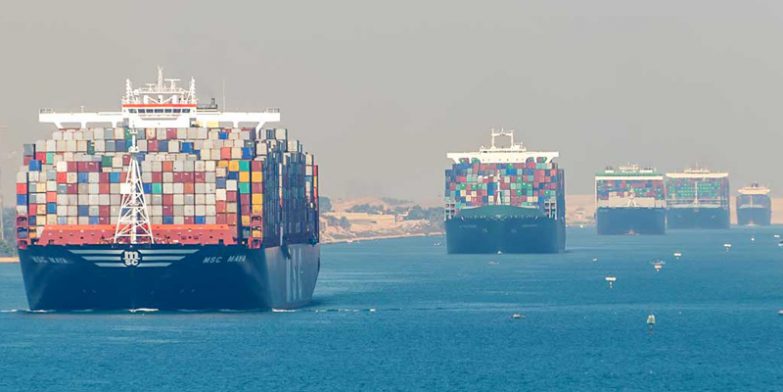
Container shipping’s return to the Suez Canal is accelerating, with almost two-thirds of Far East–Europe capacity now operating through the Red Sea.
Shorter voyages promise faster deliveries and lower operating costs, but security concerns and changing schedules mean the transition remains far from complete.
After nearly three years of widespread diversions around the Cape of Good Hope, international container shipping is entering a new phase.
Major ocean carriers are progressively restoring services through the Suez Canal, encouraged by more stable regional conditions and the considerable cost savings offered by shorter voyages.
The return is already reshaping Asia–Europe shipping networks, while selected services connecting Asia and the US East Coast are also beginning to use the waterway again.
However, carriers are proceeding at different speeds, with some maintaining alternative routes as protection against renewed disruption.
Almost two-thirds of Asia–Europe capacity returns
Recent analysis of the ten largest container carrier networks shows that 63% of deployed Far East–Europe capacity is now allocated to services transiting the Red Sea.
Of 46 direct Far East–Europe services, 24 have resumed Suez routings, representing approximately 5.5 million TEU of the 8.7 million TEU deployed across these trades.
The recovery differs between destinations:
- Far East–Mediterranean: Approximately 70% of deployed capacity now uses the Red Sea.
- Far East–Northern Europe: Around 58% has returned to the shorter route.
The figures represent a substantial shift from the extensive Cape diversions that have characterised container shipping since late 2023.
However, the percentage of deployed capacity is not the same as the proportion of individual voyages using Suez. Several services continue to operate mixed routings, with vessels transiting the Red Sea towards Europe but returning to Asia around southern Africa.
This cautious approach allows carriers to benefit from shorter westbound journeys while retaining flexibility should security conditions deteriorate.
Major carriers expand their Suez operations
The return is gathering momentum across the principal shipping alliances.
MSC resumed Suez transits in August and has subsequently operated 11 service loops through the waterway, representing approximately 2.2 million TEU of deployed capacity.
Maersk and Hapag-Lloyd have restored nine alliance services, accounting for around 1.76 million TEU, while COSCO and OOCL have resumed six services with approximately 1.27 million TEU.
CMA CGM maintained a presence throughout the disruption and has expanded its operations, with eight services representing nearly 1.3 million TEU during the latest survey period.
Premier Alliance partners are also preparing to restore additional services.
The scale of these commitments indicates that the return is becoming a structural change in shipping networks rather than a series of isolated voyages.
Nevertheless, security remains central to carrier decisions.
Although discussions have raised the possibility of a wider restoration by the first quarter of 2027, shipping lines have not committed to a universal timetable.
Further changes will depend on continuing security assessments, operational reliability and coordination with customers and alliance partners.
Asia–US services begin returning
The recovery is also extending beyond Asia–Europe shipping. On 23 October, MSC and Zim confirmed the return of their jointly operated Asia–US East Coast service to Suez routings in both directions.
The first northbound sailing departed Singapore on 18 October, with arrival in New York–New Jersey scheduled for 18 November.
Other services connecting India and the Middle East with the US East Coast have also resumed Suez transits, although some continue using the Cape of Good Hope for their return voyages.
For Asia–US services, the benefits are less straightforward than on Asia–Europe trades.
Some routes can achieve shorter transit times, but the overall outcome depends heavily on port rotations, intermediate calls and congestion at transhipment hubs.
Consequently, the return to Suez does not automatically guarantee faster deliveries for every shipment.
Shorter voyages could reshape capacity and costs
For Asia–Europe services, the return to Suez has produced average transit-time savings of approximately seven days.
Shorter voyages also reduce fuel consumption and can allow carriers to maintain service frequencies with fewer vessels.
These benefits have become particularly important as bunker fuel prices have risen sharply.
However, restoring shorter routes also releases vessel capacity previously absorbed by lengthy Cape diversions.
As more services return, that additional effective capacity could increase competition and place downward pressure on freight rates, particularly if cargo demand moderates.
The transition may also create temporary disruption.
Changes to sailing schedules and vessel rotations can cause overlapping arrivals at major European gateways, including Rotterdam and Antwerp-Bruges, increasing pressure on terminals and inland transport connections.
The short-term outlook points towards further restoration through the remainder of 2026 and into early 2027, provided security conditions remain supportive.
However, the transition is unlikely to be uniform, and individual carrier networks may continue using different routes.
With an extensive Asian network and established ocean carrier relationships, Global Forwarding helps customers evaluate changing service options, transit times and freight costs as Suez routings return.
Talk to Global Forwarding about reviewing your Asia–Europe shipping arrangements and identifying opportunities to improve transit times, reliability and cost efficiency.