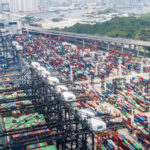

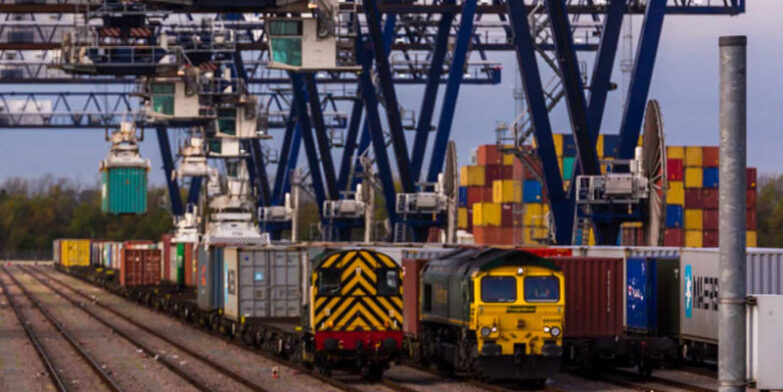
A freight train derailment in east London has severely disrupted rail connections serving London Gateway and Tilbury, impacting inland transport and raising concerns over container backlogs and road haulage capacity.
Two of Britain’s most important container gateways are facing significant inland transport disruption after a GB Railfreight container train travelling from London Gateway towards Hams Hall, Birmingham, partially derailed near Barking station at approximately 1:10pm on Friday 23 October.
Several container wagons were badly damaged, with derailed rolling stock reportedly dragged for approximately two kilometres, damaging track, overhead electrical equipment and railway infrastructure.
The incident blocked a critical freight route through Barking, Dagenham Dock, Rainham and Purfleet, creating uncertainty for importers and exporters relying on scheduled intermodal services.
With repairs expected to continue into the coming week at least and no confirmed date for full restoration, businesses are increasingly turning to road transport and alternative rail arrangements to maintain cargo movements.
London Gateway and Tilbury face different restrictions
The disruption has significantly reduced the rail capacity available to both ports.
Tilbury and Tilbury2: Forth Ports confirmed on 26 October that no freight rail services would operate during the week following the derailment.
London Gateway: DP World confirmed that it was operating a reduced rail freight service while working with Network Rail and customers to minimise disruption.
Although alternative rail routes exist, their capacity is constrained by passenger services and competing freight movements.
Freight planners are reportedly prioritising deep-sea container traffic to limit congestion at Thames Estuary terminals, but transit times to inland destinations including Hams Hall, Birch Coppice and Daventry may increase.
The extent of the resulting container backlog remains unclear, as does the timetable for restoring normal services.
Why the disruption matters for UK supply chains
London Gateway and Tilbury are important gateways for rail-connected container distribution.
Together, they normally support more than 30 daily rail services, connecting the ports with inland intermodal terminals across England, Wales and Scotland.
Rail is particularly attractive to high-volume shippers because it provides scheduled container movements, reduces dependence on road haulage and supports carbon reduction objectives.
The loss of these services therefore creates challenges extending well beyond the ports themselves.
Containers originally booked for rail may need to move by road, increasing demand for trucks and drivers at short notice.
This could create additional costs, longer collection lead times and delivery uncertainty, particularly for businesses moving large volumes to Midlands and northern distribution centres.
The disruption also illustrates the vulnerability of concentrated transport corridors. A single infrastructure failure can affect multiple ports and inland destinations simultaneously.
Shippers face difficult transport decisions
Shipping lines have already advised customers to review their inland transport arrangements.
For merchant haulage, where importers or their forwarders organise inland transport, customers are being encouraged to arrange road collections for containers that can no longer move by rail.
For carrier haulage, shipping lines are contacting affected customers to discuss alternative arrangements, although additional haulage bookings may not be accepted during the disruption.
The immediate concern is whether road transport providers have sufficient spare capacity to accommodate displaced rail volumes.
Even where trucks are available, increased demand could affect collection schedules and inland transport costs.
The challenge is not simply replacing rail with road. It is coordinating container availability, alternative transport capacity and delivery schedules quickly enough to prevent disruption spreading through the supply chain.
Until Network Rail confirms the restoration timetable, flexibility and early planning will remain essential.
If your containers are affected by the London Gateway or Tilbury rail restrictions, contact Global Forwarding to review available transport options and minimise disruption to your deliveries.