
Prospects for a negotiated settlement at Los Angeles and Long Beach are improving, but record container volumes and worsening rail delays mean shippers face operational risks regardless of whether industrial action takes place.
The threat of industrial action involving security workers at six container terminals remains unresolved, with negotiations extended until 20 November. However, senior port officials are increasingly optimistic that an agreement can be reached without disrupting operations.
At the same time, unprecedented import volumes and mounting pressure on inland rail connections are creating a separate challenge for businesses using America’s busiest container gateway.
For importers, the immediate concern is no longer simply whether a strike will happen, but whether the port complex can maintain cargo flows as congestion builds.
Confidence grows that industrial action can be avoided
The dispute involves approximately 250 security workers represented by International Longshore and Warehouse Union (ILWU) Local 26, whose contract negotiations with the Pacific Maritime Association (PMA) have continued through three extensions.
The latest agreement provides additional time for negotiations until 20 November, with support from the Federal Mediation and Conciliation Service.
Port of Los Angeles Executive Director Gene Seroka expressed confidence during a 12 November briefing that both sides could reach a satisfactory agreement, emphasising the importance of allowing negotiations to continue.
He also confirmed that the dispute has not affected port operations, despite exceptionally high cargo volumes and a substantial pipeline of incoming vessels.
That optimism is encouraging. However, the potential consequences of industrial action remain significant. Other ILWU members, including longshore workers and marine clerks, could decline to cross security workers’ picket lines, potentially disrupting cargo handling, terminal access and vessel operations.
Although the immediate risk appears to be easing, shippers cannot yet rule out disruption.
Record imports are testing port capacity
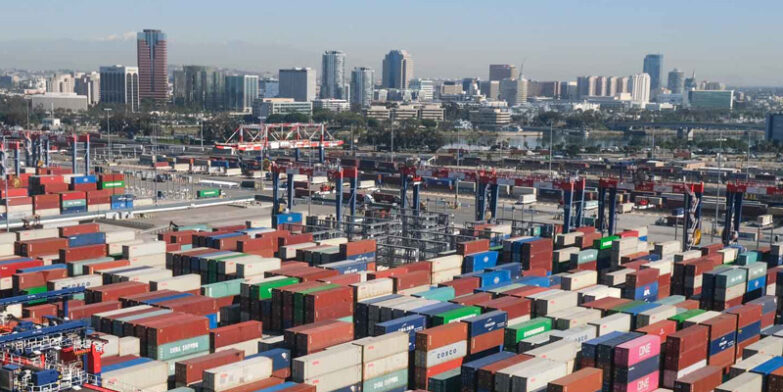
The Port of Los Angeles handled a record 1.027 million TEU in October, its fifth consecutive month of record-breaking container throughput.
Volumes reached 9.1 million TEU during the first ten months of 2026, approximately 5% ahead of the same period last year.
The wider import picture is equally striking. US container imports from Asia reached an all-time monthly high of 1.9 million TEU in October, with approximately half moving through Los Angeles and Long Beach.
Strong consumer demand, a temporary easing of US-China trade tensions and continuing disruption affecting alternative shipping routes have contributed to sustained traffic through Southern California.
Import arrivals are expected to remain well above normal levels:
- 268,000 laden TEU forecast for the week commencing 9 November.
- 315,000 laden TEU expected during the week commencing 16 November.
- 289,000 laden TEU forecast for the week commencing 23 November.
Typical weekly imports are approximately 200,000 laden TEU, meaning the peak forecast is more than 50% above normal levels.
These volumes are putting increasing pressure on terminals and inland connections, particularly rail services.
<4>Rail delays are already compromising cargo flows
While vessel and terminal operations have continued without strike-related disruption, inland rail congestion has become a growing concern.
Rail-bound container dwell times reached two-year highs in October, approaching ten days at Los Angeles and eight days at Long Beach.
By 12 November, approximately 9,500 rail containers at Los Angeles had been waiting nine days or longer. Around three-quarters were associated with BNSF services, with significant concentrations at individual terminals.
Across the port complex, industry estimates suggest approximately 27,000 containers were awaiting rail loading, including around 8,000 that had already been waiting more than nine days.
The situation has been aggravated by flooding in New Mexico and Arizona, which damaged part of BNSF’s Southern Transcon network and temporarily restricted rail movements.
Although the affected track has been repaired, the subsequent surge in train movements is placing additional pressure on terminals, rail equipment, crews and inland facilities.
Some containers have reportedly experienced delays of up to 30 days, while congestion is beginning to affect local trucking and drayage operations.
Conditions vary considerably between terminals and rail operators. Facilities primarily served by Union Pacific have generally reported fewer problems, while some BNSF-dependent terminals have introduced additional measures to manage backlogs.
Long Beach Container Terminal, for example, is operating gates around the clock and encouraging the movement of some rail-bound containers to off-dock facilities.
These measures should help restore fluidity, but recovery will depend on how quickly rail networks absorb accumulated volumes.
Disruption remains possible without a strike
The combination of record imports, extended rail dwell times and recovering inland networks means that cargo delays could persist even if the labour dispute is settled.
As containers accumulate, terminals have less space to accommodate incoming cargo. Delayed rail departures can also create difficulties for drayage operators, affecting equipment availability and onward deliveries.
The consequences can extend well beyond Southern California, particularly for importers relying on intermodal rail services to reach inland distribution centres.
A strike would introduce another layer of uncertainty into an already stretched system, potentially creating backlogs that take considerable time to clear.
However, the absence of industrial action would not automatically resolve the underlying congestion.
For shippers, the distinction between labour risk and operational congestion is important. One may be resolved through negotiation, while the other requires sustained improvements in cargo movement and inland transport capacity.
Importers with shipments approaching Southern California should establish which terminals will receive their containers, identify the relevant rail operator and assess current inland transport arrangements.
For time-sensitive shipments, alternative rail connections, off-dock transfers or direct trucking may offer practical options, depending on cargo destination, equipment availability and cost.
Importers should also review delivery commitments and potential exposure to demurrage, detention and storage charges, particularly where extended dwell times could affect container collection.
Global Forwarding support customers with shipment visibility and practical contingency planning, helping businesses identify potential delays and assess alternative arrangements before cargo commitments are affected.
With strong connections across Asia and the US, our teams can help importers evaluate their exposure to Southern California congestion and identify suitable options for protecting time-sensitive shipments.