


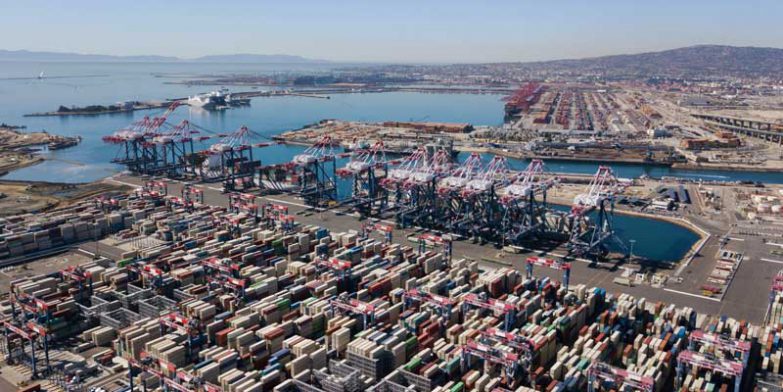
Transpacific container shipping has entered August on a firmer footing. Resilient US import demand, operational disruption in China and active carrier capacity management are supporting renewed freight-rate increases after several weeks of market correction.
Early August, Shanghai–New York spot rates increased 4% week on week, while Shanghai–Los Angeles rates were up 3%, while earlier market indicators recorded increases of more than 12% on both US West Coast and East Coast trades compared with late July, indicating that carriers have gained traction with their latest general rate increases.
Import demand remains more resilient than expected
The anticipated slowdown after the spring front-loading period has not emerged as quickly as expected. US imports remain firm into August, supported by inventory replenishment, stronger retail requirements and continued demand linked to technology and infrastructure investment.
Los Angeles and Long Beach continue to handle significant inbound volumes, with elevated weekly imports expected through mid-August.
At the same time, disruption across Central and South China is contributing to container and vessel-space shortages. Carriers are reinforcing these constraints through blank sailings. Across the major East–West trades, 49 blank sailings are expected from week 34 to week 38, representing a 7% cancellation rate, with disruptions concentrated on the Transpacific eastbound trade (59% of cancellations
Capacity from Asia to the US West Coast was also projected to decline by around 3% between July and August. The combination of resilient cargo volumes, congested export markets and reduced scheduled sailings has enabled carriers to rebuild rates after the decline seen in July.
East Coast services face additional pressure
Capacity conditions are diverging between the US West Coast and East Coast. Additional loader capacity on West Coast services has helped limit the scale of rate increases on those routes. East Coast services, by contrast, have experienced greater upward pressure, widening the difference between the two routing options.
By mid-August, North Asia–US East Coast spot rates had risen by approximately 10% in one week, reaching their highest level in more than two years according to one market benchmark.
The East Coast also faces additional risk through the Panama Canal. El Niño conditions have reduced water levels in Gatun Lake, prompting the Panama Canal Authority to announce further reductions in the maximum authorised draft for Neopanamax vessels during late August and early September.
While daily transit numbers are not currently expected to decline, lower draft limits can reduce the amount of cargo carried by individual vessels. This is particularly relevant to US East and Gulf Coast services, as more than half of Neopanamax vessels calling these gateways since May have transited the canal.
Carriers have already begun applying Panama Canal surcharges on affected services. Further vessel-capacity restrictions during peak season could provide additional support for East Coast freight rates and make early space planning increasingly important.
Choose routings for resilience, not rate alone
The current market is finely balanced. Demand remains stronger than anticipated, Chinese port congestion continues to restrict equipment and shipping space, and blank sailings are helping carriers align capacity with volumes. Panama Canal restrictions introduce a further potential constraint for services routed to the US East and Gulf coasts.
The latest rate rises suggest current GRIs have market stickiness, although the pace of volatility could moderate if capacity remains relatively stable. For shippers, the priority should be to consider the whole supply chain rather than selecting a route solely on the lowest available ocean rate.
Key considerations include:
- Equipment and vessel-space availability at the Asian origin.
- Service reliability and the operational position of individual ports.
- West Coast versus East Coast entry strategies.
- Panama Canal exposure, surcharges and capacity risks.
- Inland transport requirements, inventory levels and delivery commitments.
Global Forwarding works closely with colleagues across the Hecny Group in Asia to assess carrier options, port pairs, transit times and alternative routings. We also provide customs brokerage support at gateways nationwide, alongside inland transport management and distribution solutions.
Together, we help you make better-informed transpacific shipping decisions as capacity and pricing conditions evolve.
Contact Global Forwarding to review your transpacific shipping strategy, secure space early and protect the flow of cargo across your wider supply chain.