

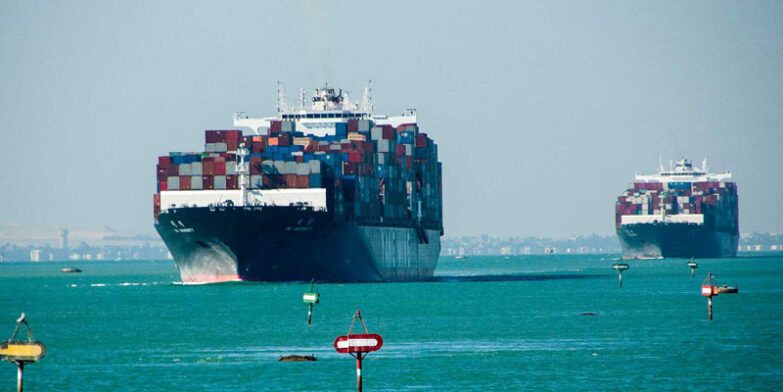
Asia–Europe container shipping is entering a new phase, with Suez and the Cape of Good Hope increasingly operating as parallel routing options rather than the market moving immediately back to a single established route.
Several major carriers have selectively restored Red Sea transits, attracted by shorter voyages, faster equipment circulation and lower operating costs. But security concerns remain, and shipping lines continue to retain Cape routings where they consider them necessary.
For shippers, this creates both opportunity and complexity. Faster Suez services could improve transit times, but mixed routings can also produce changing arrival dates, overlapping vessel calls and differences in costs between individual services.
Two routes, different calculations
The return to Suez remains selective rather than network-wide. Maersk, Hapag-Lloyd, CMA CGM, MSC and Cosco have increased or resumed Red Sea transits to varying degrees, assessing individual services against security, insurance and operational considerations.
Within the Gemini Cooperation, selected Asia–Mediterranean and Asia–Europe services have returned to the canal. Maersk’s AE2/NE1 Asia–North Europe service resumed westbound Suez transits in August, while other services continued around southern Africa.
MSC has also tested the corridor, with seven vessels reportedly crossing the Red Sea within two weeks, while CMA CGM and Maersk have added further Suez-routed services.
Rather than signalling an immediate return to pre-crisis operations, these developments point towards a period in which carriers may switch or maintain individual services according to changing conditions.
The Cape comes with a capacity penalty
Security made the Cape of Good Hope an essential alternative, but the longer route has fundamentally changed the economics of Asia–Europe shipping.
Additional sailing days consume more fuel and keep vessels and containers tied up for longer. Carriers need more ships to maintain weekly schedules, while slower container circulation can leave exporters waiting for equipment to return to Asian origins.
The effects extend across the supply chain. Longer rotations make schedules harder to recover following congestion, absorb capacity that could otherwise support additional sailings and increase inventory transit times for importers.
For a 20K TEU Ultra Large ContainerVessel (ULCV), fuel expenditure on a Cape-routed voyage can exceed $6,000,000.
That makes the attraction of Suez clear: every voyage returned to the shorter route has the potential to release vessel capacity, improve equipment circulation and reduce operating costs.
Suez carries its own premium
The shorter route does not automatically make it the cheaper or easier option.
The Bab el-Mandeb Strait remains exposed to war risk, requiring carriers and insurers to continually assess security conditions.
Additional insurance premiums can represent a significant cost for vessels worth hundreds of millions of dollars. The average cost of a ULCV ranges from $150 million to $200, that equates to approximately $750,000 to $1,000,000 for the transit.
Carriers must balance that exposure against the additional fuel, vessel time and equipment costs created by sailing around Africa.
This makes routing an economic decision as well as a security decision.
As those calculations change, individual services could move between the two routes – potentially at relatively short notice.
Faster vessels could catch slower services
Shorter transit times would be one of the clearest benefits of a wider return to Suez, but the transition itself could create disruption.
A vessel travelling through Suez can arrive significantly earlier than one that departed Asia previously but sailed around the Cape. As more services return to the shorter route, arrival ports could experience overlapping arrivals.
The knock-on effects could extend to terminals, customs operations, haulage, warehousing and final delivery.
Importers may therefore need to pay closer attention to individual vessels and bookings rather than relying on standard transit times for an entire trade lane.
A shipment scheduled around a longer Cape transit could suddenly require earlier customs clearance, transport or warehouse availability if its service switches to Suez.
Routing becomes part of shipment planning
The changing environment makes several questions increasingly important for Asia–Europe shippers:
- Will the booked service travel through Suez or around the Cape?
- Could the carrier change that routing before or during the voyage?
- How would a shorter or longer transit affect inventory and delivery planning?
- Could changing arrivals affect warehouse, customs or inland transport arrangements?
- What security, fuel or routing surcharges apply?
- What contingency is available if disruption forces another diversion?
These considerations are particularly relevant as businesses manage peak-season inventory and year-end requirements.
A shorter transit can provide a valuable supply-chain advantage, but only if businesses are prepared for the resulting arrival date.
A more fluid Asia–Europe market
The gradual return to Suez is positive for global container shipping. Shorter voyages can release effective capacity, improve container circulation and potentially support greater schedule efficiency.
However, the transition is unlikely to happen uniformly. For the immediate future, Asia–Europe shipping may operate with a mixture of Suez and Cape services as carriers continually reassess security, insurance, operating costs and network requirements.
That makes visibility at origin and close attention to individual bookings particularly valuable.
With Hecny’s extensive presence across Asia and Global Forwarding teams supporting customers in the US and Europe, we can help shippers understand changing routing options and their potential impact on transit times and delivery planning.
If you have upcoming Asia–Europe shipments and would like to discuss how the evolving Suez situation could affect your plans, talk to Global Forwarding about the options available.