
Ocean and airfreight markets are entering Q4 under renewed pressure, with strong trans-Pacific demand, Asian port congestion and growing hi-tech shipments extending peak-season conditions and creating fresh challenges for international shippers.
China’s Golden Week holiday (1–7 October) has temporarily slowed export activity, but the underlying freight market remains unsettled. Successive typhoons, port congestion and disrupted vessel schedules have reduced effective ocean capacity, while strong demand for AI infrastructure and technology equipment is pushing trans-Pacific airfreight towards an unusually prolonged peak.
The result is a market where headline freight rates tell only part of the story. Even where ocean pricing stabilises or softens, securing reliable capacity and maintaining predictable delivery schedules remain significant challenges.
Trans-Pacific ocean capacity could fall 20%
The trans-Pacific remains the principal pressure point for ocean freight, with industry estimates suggesting effective capacity could be 15–20% lower in October than September.
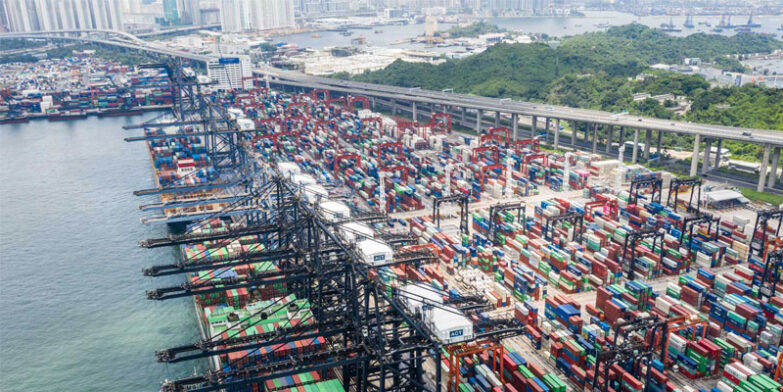
Severe congestion across major Chinese ports has displaced vessels and containers, creating backlogs that will take time to clear. Shanghai is expected to remain heavily congested into mid-to-late October, with berthing waits exceeding five days.
Recent on-time performance was just 21% at Shanghai and 34.6% at Ningbo, demonstrating how severely vessel rotations have been affected.
These delays have consequences far beyond individual ports. Late vessels arrive outside their allocated berthing windows, creating bunching, disrupting onward connections and tying up containers and ships that would otherwise be available for new shipments.
At the same time, US-bound demand remains resilient. Consumer imports and growing volumes of infrastructure and equipment associated with data-centre development are supporting cargo flows, while US West Coast gateways are preparing for another substantial influx of shipments.
With Chinese factories resuming production after Golden Week, another wave of bookings could reach an already stretched network.
Ocean rates stabilise, but schedules remain unreliable
Following September’s sharp increases, trans-Pacific ocean pricing has begun to plateau.
The latest World Container Index showed Shanghai–New York rates increasing 1% week on week, while Shanghai–Los Angeles remained unchanged.
However, carriers continue to manage supply through blank sailings. Across the major east–west trades, 39 cancellations are expected between weeks 41 and 45, with almost half concentrated on the eastbound trans-Pacific.
Confirmed bookings remain vulnerable to rolling or cancellation because of vessel space and weight restrictions, while unpredictable arrivals complicate terminal operations and inland distribution.
Although rates could soften as congestion eases, recovering Chinese production, accumulated cargo and selective capacity withdrawals may limit any decline.
For time-sensitive shipments, dependable sailings and confirmed space may therefore prove more valuable than waiting for a potentially lower spot rate.
Airfreight peak accelerates as hi-tech demand surges
Trans-Pacific airfreight is experiencing equally strong pressure, although the underlying demand drivers are increasingly different from those of a traditional retail peak.
AI infrastructure, servers, semiconductors, data-centre equipment and energy-storage systems are generating substantial cargo flows from Asian manufacturing centres towards North America.
Trans-Pacific airfreight volumes increased approximately 10% year on year during September, while Asia-Pacific tonnage to the US was recently running 14% above last year.
Outbound Asian load factors have approached 90%, despite airlines introducing additional Pacific capacity.
The latest pricing figures reflect the strength of demand. The global Baltic Air Freight Index increased 5% in the week to 5 October, reaching 25.5% above the corresponding period last year.
Hong Kong outbound rates rose 3% week on week and were 22.3% higher year on year, while Shanghai increased 2.2% and remained 18.3% above last year’s levels.
Capacity growth has struggled to match demand. Global air cargo tonnage was recently 5% higher year on year, compared with capacity growth of approximately 3%.
Technology demand is changing the peak-season pattern
The expansion of AI infrastructure is creating a potentially more sustained source of airfreight demand.
Hi-tech cargo volumes increased 22% year on year during the first seven months of 2026, significantly outpacing overall airfreight growth.
Manufacturing diversification is also changing established trade flows. Taiwan, South Korea, Vietnam, Malaysia and other Asian production centres are generating increasing volumes of high-value cargo destined for the US.
Unlike seasonal consumer products, technology infrastructure shipments are linked to investment programmes, equipment installation schedules and ongoing replacement cycles.
Consequently, demand could remain elevated beyond the conventional Q4 peak.
Higher operating costs are adding pressure, with jet fuel prices more than doubling year on year by early October. Combined with high load factors and limited capacity growth, this could sustain firm airfreight pricing through the remainder of the quarter.
Other trades face contrasting pressures
While the trans-Pacific remains particularly tight, conditions elsewhere demonstrate how uneven the global freight market has become.
Asia–Europe ocean rates have been declining, with the gradual return of some services to the Suez Canal potentially restoring additional effective capacity.
However, Asian port congestion, blank sailings and displaced schedules continue to create disruption, even where underlying freight rates are falling.
Asia–East Coast South America is experiencing a different combination of strong trade growth and carrier rate management. Volumes increased 21% year on year between January and July, although rates have subsequently retreated from their September peak.
Carriers are pursuing fresh increases from mid-October, but additional capacity scheduled for November could make these difficult to sustain.
Across all three trades, the central challenge remains the same: capacity, pricing and schedule reliability are not necessarily moving together.
Global’s Asian network gives shippers a stronger response
With disruption concentrated across Asian manufacturing and export markets, access to reliable local intelligence, carrier relationships and alternative shipping options has become increasingly valuable.
As part of the Hecny Group, Global Forwarding’s extensive Asian network, includes 12 offices across China, giving its customers a significant advantage when capacity tightens and schedules become unpredictable.
Our China offices are located close to principal manufacturing centres and export gateways, providing local market insight, direct coordination with vendors and access to established ocean and airfreight carrier relationships.
That presence enables Global Forwarding to identify emerging congestion, assess alternative gateways and routings, coordinate bookings and respond quickly when planned movements are disrupted.
When trans-Pacific capacity is under pressure, local knowledge and direct access to the market make a real difference.
Whether you need dependable ocean space, priority airfreight capacity, alternative routings or support with urgent high-value cargo, the Global Forwarding team in the US and colleagues across Asia can help you find the most effective solution.
Talk to Global Forwarding about your Q4 shipments and put the strength of our Asian network and offices across China to work for your supply chain.