


As disruption across the Middle East continues to restrict traditional ocean and air freight routes, inland transport networks are being pushed to the forefront of supply chain execution.
What was initially a contingency measure is now a critical operating model, with road and multimodal solutions carrying increasing volumes into Gulf markets. This shift is not simply a rerouting exercise, it is fundamentally changing how cargo moves through the region.
Shipments originally bound for established hubs are now being discharged at alternative ports and redistributed inland, often via multiple handoffs and non-standard routes. While this flexibility is keeping supply chains moving, it is also placing significant strain on infrastructure that was never designed to support sustained, high-volume container flows.
Capacity pressure builds across key regional corridors
The rapid redirection of cargo inland is tightening trucking capacity across major corridors linking Oman, the UAE and Saudi Arabia. Vehicle availability is becoming increasingly constrained, while extended transit times and delays at collection points are reducing overall network efficiency.
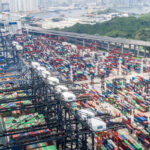
At key staging locations, congestion is intensifying. Terminals are operating at or near capacity, with dwell times extending and truck queues forming as cargo competes for onward movement. At the same time, cross-border processes are becoming more complex.
Driver shortages, driven in part by visa delays and regulatory restrictions, are limiting utilisation, while additional controls on routes and operating permissions are adding friction to already stretched networks.
These combined pressures are driving both cost escalation and unpredictability. In time-critical scenarios, rates are rising sharply as shippers compete for limited capacity, while transit reliability is becoming increasingly difficult to maintain.
Network disruption exposes operational vulnerability
Recent disruption at key gateway ports has underlined the fragility of current inland flows. When a primary staging point is impacted, the effect is immediate—interrupting cargo discharge, delaying onward trucking and placing further pressure on alternative corridors.
Even where operations resume quickly, throughput constraints and backlog recovery continue to affect performance. This highlights a broader challenge: overland networks are now a central part of regional supply chains, but they remain sensitive to disruption at critical nodes.
Maintaining control through integrated logistics
In this environment, coordination across modes and regions is critical. By combining local expertise with established multimodal networks, Global Forwarding is supporting customers with flexible routing strategies that bridge gaps created by disrupted ocean and air services.
Through proactive capacity management, cross-border coordination and real-time visibility, Global helps maintain cargo flow while reducing exposure to delay and cost escalation. Alternative gateways, bonded trucking solutions and integrated air-road options are deployed dynamically, based on evolving conditions across the region.
Contact us now to learn how Global Forwarding can support your operations with flexible inland, multimodal and end-to-end logistics solutions.